Adaptive therapy under parametric, structural, and measurement uncertainty
AP Browning, RM Crossley, RJ Murphy, H Byrne, S Hamis
Preprint

AP Browning, RM Crossley, RJ Murphy, H Byrne, S Hamis
Preprint
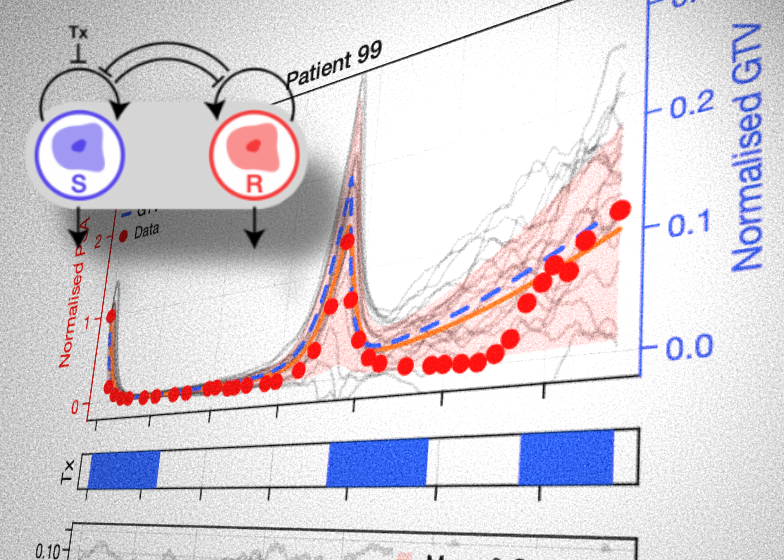
Adaptive therapy has emerged as a promising treatment strategy that exploits within-tumour competition to delay disease progression. Implementation, however, typically relies on indirect measurements of tumour burden and must account for potentially substantial patient heterogeneity. In this work, we capture patient-to-patient variability, parameter uncertainty, and imperfect biomarker measurements with a mathematical and statistical model that we calibrate to clinical prostate cancer data using a Bayesian inference framework. We use the resulting virtual cohort to demonstrate that, within the simple but now well-established Lotka-Volterra-based model, adaptive therapy robustly improves time-to-progression for the subset of patients that are predicted to eventually progress by the model. To account for other risk factors associated with larger tumour volumes, we introduce a new metric based on the risk of metastasis that demonstrates how adaptive therapy may be disadvantageous when sustained tumour burden is also considered. Given the ubiquity of uncertainty in oncology, we then describe several future modelling directions that also capture uncertainty in the temporal evolution of the underlying tumour or biomarker dynamics. Finally, we demonstrate how model misspecification and non-identifiability can lead to unreliable predictions, especially if uncertainty is inadequately captured.